
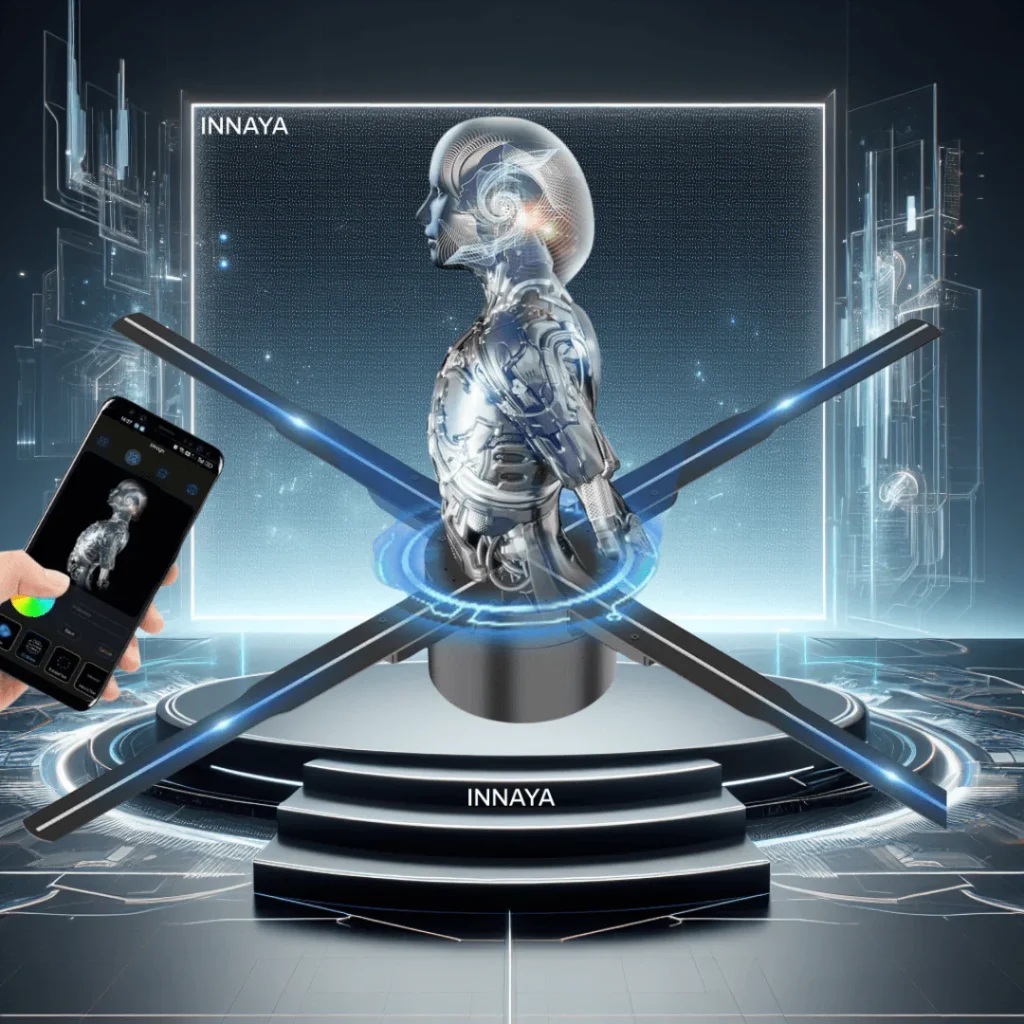
Walk past any busy retail store or trade show booth these days and there’s a solid chance something catches your eye that shouldn’t be possible — a glowing, spinning object floating in mid-air, vivid and lifelike, with no screen in sight. What you’re seeing is a 3D holographic fan display, and if you haven’t experienced one up close yet, you’re in for a proper jaw-drop moment when you do.
These devices have quietly moved from novelty tech into real-world marketing tools, and for good reason. They’re attention-grabbing in a way that static banners and even HD screens simply can’t compete with. But what exactly are they, how do they work, and who actually benefits from using one? Let’s break it all down.
What Is a 3D Holographic Fan?
A 3D holographic fan — sometimes called an LED fan display or hologram projector fan — is a spinning LED device that uses the phenomenon known as persistence of vision (POV) to create the illusion of a three-dimensional image floating in thin air. The blades of the fan spin at high speed, and because the LEDs along each blade light up at precisely timed intervals, the human eye perceives a complete, seamless image rather than individual light points.
The result is a visual that appears to be hovering in front of you. Logos rotate slowly in three dimensions. Products appear to spin on invisible stands. Characters seem to float above the device itself. It’s the kind of effect that people stop and stare at — and more importantly, remember.
How the Technology Actually Works
The science behind these fans is genuinely clever. Each blade is lined with densely packed LED lights, typically ranging from a few hundred to over a thousand individual LEDs depending on the model. A motor spins these blades at roughly 700–900 RPM. As the blades rotate, a microcontroller triggers specific LEDs at specific moments in the rotation cycle — essentially painting a slice of an image with each pass. Because the human eye retains visual impressions for a fraction of a second after they disappear (the basis of all motion pictures), the rapid sequence of light slices blends into a single coherent image.
Higher-end models achieve this at 4K resolution and can synchronize multiple fan units together to create even larger composite displays. The images themselves are uploaded via Wi-Fi or a memory card, and most modern units come with companion software that allows users to upload custom content, set schedules, and even control brightness levels remotely.
Where Are They Being Used?
The short answer: nearly everywhere that visual marketing matters. Retail stores have been among the earliest and most enthusiastic adopters. A 3D hologram fan mounted near a product display can increase foot traffic to that area dramatically — simply because people are curious and want to see what’s going on. Restaurants use them to highlight featured menu items. Car dealerships project vehicle models rotating in three dimensions. Hotels display their logos and promotional content in lobbies.
Beyond retail, event management companies have latched onto holographic fans for exhibitions and brand activations. Wedding planners have started offering them as premium centrepiece alternatives. Even medical device companies and pharmaceutical brands are using them for educational displays at conferences — showing how a product works internally, in three dimensions, without requiring physical props.
Small businesses have found them to be a surprisingly affordable way to make a big visual impact. Compared to commissioning a full digital display wall, a compact 16-inch hologram advertising fan delivers remarkable bang for the buck and can be up and running within minutes of unpacking.
Choosing the Right Size and Spec
Size matters quite a bit with these units, and it’s one of the first things buyers need to think about. A 16-inch fan works well on a retail counter or desktop display — close-range viewing, compact footprint, easy to move around. Step up to a 23-inch unit and you’re looking at something suitable for mid-sized retail environments, small event booths, or restaurant entryways. Go bigger — say, 39 inches or an 80cm outdoor unit — and you’re dealing with serious commercial-grade hardware that can command attention across a busy floor.
LED count and resolution also matter. Entry-level fans may produce noticeably pixelated images at close range, while premium models offer resolutions high enough to display detailed product photography or fine logo work without any degradation. If you’re showing text, resolution is especially important — blurry lettering is a poor look for any brand.
Connectivity is another consideration. Wi-Fi enabled fans allow for remote content updates, which is invaluable for businesses running promotional campaigns that need to change regularly. SD card-only models are cheaper but require physical access to update content. For businesses managing multiple display locations, remote control capability is practically a necessity.
If you’re looking to invest in a high-quality unit suited for professional advertising, the INNAYA H23 3D Advertising Hologram Fan is a well-regarded option offering four blades, 720 LEDs, and a 1600×720 resolution — capable of producing crisp, vivid displays that genuinely impress.
Content Creation for Holographic Displays
One question that comes up often is: how complicated is it to create content for these fans? The answer has gotten considerably simpler in recent years. Most manufacturers now offer web-based or desktop software that accepts standard video files (MP4 being the most common format) and optimises them for holographic display. Some platforms also provide libraries of pre-made holographic content that can be purchased and customised.
The key technical requirement is that content needs to be rendered against a black background. Because the fan’s blades are dark, black pixels effectively “disappear” during projection — which is what creates the floating image effect. Any content with a black background will appear to float in mid-air. Content designers familiar with basic video editing software can typically create compelling holographic assets without needing any specialist training.
The Bottom Line
3D holographic fans are no longer an exotic curiosity — they’re a practical, accessible, and genuinely effective visual communication tool. Whether you’re a small business owner trying to stand out from the competition, a marketing professional sourcing eye-catching event displays, or simply someone curious about where visual technology is heading, holographic fans represent one of those rare moments where the future arrives looking exactly as cool as you hoped it would.
The technology continues to improve rapidly, with costs coming down and capabilities going up. There’s never been a better time to explore what a well-placed holographic display can do for a brand or space.